
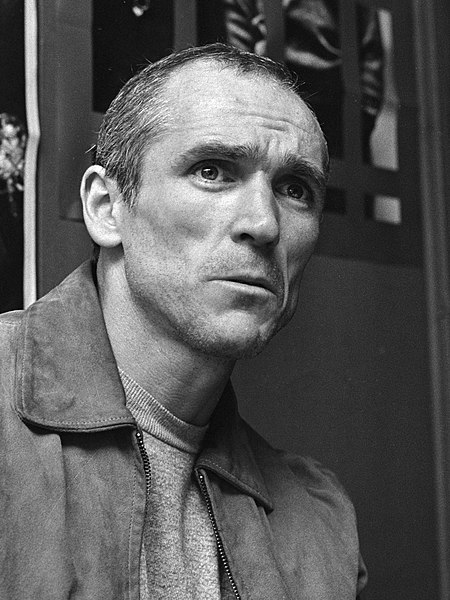
My brief encounter with a notorious villain
I once spent half a day with John Mcvicar, the armed robber and notorious prison breaker. He had committed various offences during his criminal career in the 1960s and 70s including armed robbery, a series of crimes which once earned him the title of the most dangerous man in Britain. He was however intelligent and opportunistic and took a sociology degree whilst in prison and later continued his postgraduate studies after parole.
In 1980 I was in my last year at university studying social sciences in London, and was on the committee of our college academic forum. I was tasked with inviting mcvicar to talk, with introducing him to the audience and managing the question and answer session, and hosting him down the pub afterwards. I didn’t realise until later that there had been a conversation about who should do this as people were somewhat reluctant to manage him given his reputation. Rather like my later and short lived career at the sharp end of psychiatry it wasn’t that I was brave or suitable for the job just that I was naive enough and stupid enough to do it and happened to be in the wrong place at the right time.
My enduring memory of that day is that I was in the company of one of the most miserable men I’ve ever met, who did not attempt even a ghost of a smile, and whose head was permanently cocked slightly downward and to one side like a bird with a worm in its beak. The only thing I remember of the event itself is that everyone seemed to be in awe of him, including the lecturers that attended who of course focused on questions of sociology, justice and prison experience. From their perspective most prisoners were victims of a system focused on repression rather than rehabilitation, a view I have some sympathy with, although when you find yourself in the company of a clever man like John McVicar it is tempered by the view that he probably had a pretty good idea of what he was doing a lot of the time.
This was Thatcher’s Britain of course and politics were everywhere. Mcvicar was often called on by periodicals like Time Out as he developed his journalistic career and published his autobiography which was later made into a film starring Roger Daltrey of The Who. The film in fact premiered a few months after I met him which was just as well as he emerged from that as a minor celebrity and I doubt very much whether he would have accepted an invite then to talk to a small bunch of students and intellectuals in a South London College for a fee of twenty pounds and a free lunch.
The most surreal part of the whole experience was going to a Brockley pub afterwards. We had three or four beers and if I remember rightly a plate of sandwiches. Fifteen minutes in I was struggling to make small talk and certainly was unlikely to light any intellectual fires with a man who had been taught sociology by the great Laurie Taylor. It was then that two women who I did not know came to my rescue by sitting down with us uninvited and initiating a conversation. This allowed me to become a spectator to a discussion which was far more genuine than anything I could have carried off. They were not students and they were not lecturers; they were two young South London women who wanted to talk to John and debate with him how he was letting down working class people everywhere by not using his recently acquired status as a celebrity ex convict to highlight the real reasons why ordinary people ended up in prison. It was the same agenda as my sociology lecturers had but coming from a very different perspective. To my discomfort the conversation became quite heated as they were very clearly advocates not just for working class rights but of women’s rights. Mcvicar was not entirely enlightened in these areas. In his autobiography he had described how he ended up having sex with a student who came to interview him. In fact he went so far as to describe the quality of the sex and the time they spent together which included him taking her on a field trip to see one of the prisons he had been incarcerated in. Not the act of a gentleman.
I recall slipping away mid afternoon and leaving them to it with an excuse about having to attend a lecture, which was as implausible as it was untrue.
A friend of mine joined the prison service when we both graduated and we often discussed McVicar’s appearances in the media. There was apparently a theory in Her Majesty’s penal services that the academic and rehabilitative image was a facade and that he was planning some great caper that he would never be caught or successfully prosecuted for. Unless he was very successful and there is some great unsolved case out there that is yet to be uncovered, we will never know.
Mcvicar died on the 6th of September 2022 two days before Queen Elizabeth. By then he was living alone with his dog in a caravan in Essex his second marriage having ended in separation, and his one child, a son with his first wife, having followed him into crime and jail for art theft. The two of them had been estranged for 25 years as McVicar did not, ironically, approve of his son’s career choices. In his guardian obituary Laurie Taylor is quoted as saying that he thought McVcar may have isolated himself in his later years as he was ashamed of his physical decay. He was famous throughout his life for his bodybuilding and maintaining his physique and it was likely that he did not want anyone to see him ageing.
Apparently he was out walking his dog and had a heart attack when he died. I have this vision of him passing alone, still as unsmiling as he was on the day that I had met him, and I have to confess that when I read this my first concern was for the dog not for the man. I’m sure he was loved by some people but by all accounts he was not an easy person to love or even to like. As for the great British justice system this remains broken 42 years later and there is once again an extreme right wing Tory government in charge and no real sign of progress. McvVickars Wikipedia entry ambiguously says that he was “trained” in borstall as a young man. This could be read as meaning that he received vocational training – or alternatively that he was trained for a career in crime. I suspect it was the latter and I suspect that nothing has changed today in that respect. The best place to learn how to become a criminal is undoubtedly in prison.
Photo courtesy of Wikipedia Creative Commons
 Eyecatching