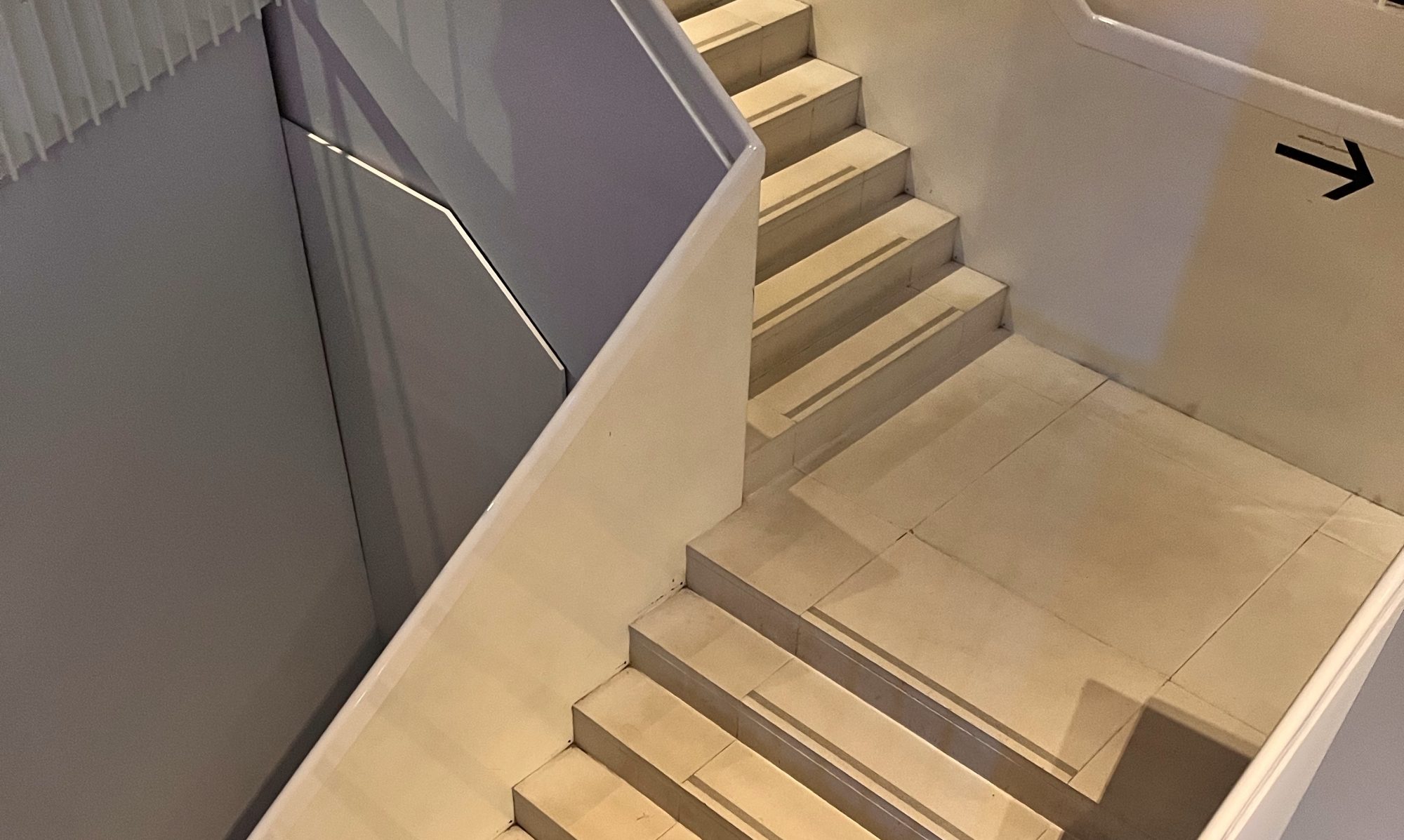
In this week’s Eyecatching Words I’ll be covering the usual news and absurdities of life, and in particular focusing on the transformation of the BT Tower, rituals associated with Hindu houses, a new exhibition of the artist Frank Auerbach, people watching at Gatwick, and the need not to panic when confronted with information overload.
>
I seem to be on a roll when it comes to predictions. Last week I made a case for getting rid of trident. This bothered Grant Schapps, Defence Minister, so much that he went up to Scotland to watch a test firing of Britain’s most expensive American import. For the second time in recent years it all went terribly wrong and the missile had to be destroyed in flight. Oops.
I also noted that when it comes to Gaza “We have become hooked on semantics in the face of tragedy.” Lo and behold the whole thing blew up this week with procedural and personal mudslinging in Parliament obscuring the real need for action. Tim Shipman from The Times tweeted that “I love Parliament. Debate is important. But the amount of hot air being produced today on a motion/amendments which will make LITERALLY NO DIFFERENCE to any of the people in Gaza or Israel is quite staggeringly pointless and evidence of disturbing levels of self-regard.” Case proven.
2024 is undoubtedly a nexus point in history from the perspective of both Gaza and the Ukraine. But it is also a time when we have to decide whether there is such a thing as international rules based order, or at least the aspiration to try and create and maintain one. It is a time when we have to determine whether the future is about quasi-autocratic regimes or something different. Democracy no longer cuts the mustard as it is too easily corrupted and even discarded. Putin, Trump, Oban, Modi and others have all used it as a vehicle for their own psychopathic aspirations, packing the polls with populist tropes that enable them to get what they want. This week saw the Ukraine having to concede ground to the Russians, in no small part due to the failure by America to provide military support. Gaza reached a tipping point with a crescendo of demand for a ceasefire by even those who had shied away from it up until now. Putin’s great bugbear Alex Navalny died mysteriously in prison and was undoubtedly either murdered or died as a result of the daily regime he was being subjected to. Not only was it not a good week it was one that leaves us closer than ever to failure as a global order. This is what 2024 is about.
Around the world it is right wingers who are trying to manipulate reality. The theme continued this week when Liz Truss addressed a far right forum in America and shared a platform with the likes of Trump, Steve Bannon and Nigel Farage. Her main cry of woe was that she had been thwarted by Britain’s very own version of The Deep State and that it was now impossible to govern the country in the name of ordinary people because it was being run by technocrats, bureaucrats and cricket bats. Okay maybe not the last of those, but as her whole thesis is nonsensical there is no harm in throwing it in. Any woman whose leadership tenure was measured in lettuces cannot be taken seriously.
What Truss does not understand is that the reason we have rules and bureaucracies is to stop people like her from acting like Caligula on steroids. What she calls a conspiracy is actually no more than a set of safeguards and what she calls the deep state is actually people coming together to stop things from going off the rails. But toys-out-of-the-pram truss can’t understand what the rest of us all knew, namely that she was a joke that turned bad and put the country into ruinous meltdown. And the indispensable fact is that both here and in America, if there was such a thing as a deep state it would have stopped the likes of her and Trump getting into power. The very fact of her making it to Downing Street shows that there was no conspiracy, and the fact that she was removed by her own party is proof that it is politics, not bureaucracy or technocracy that is the real danger to ordinary people’s lives.
I was fascinated to see that the BT tower is to be turned into a hotel, but not particularly saddened. In fact maybe more people will get to see it as a result. It is a 1960s icon on the landscape of London and will remain so whatever its use. I was born in 1958 and when I was a boy my father took me on a day trip to see the new building in the morning and then on to see St Pauls in the afternoon. I think he thought it would be a good contrast of new and old. Not long afterwards it was featured in the Dr Who four-parter The War Machines; the team couldn’t resist the idea of putting a mad computer bent on global domination in to the new building, which just shows that AI takeover is not a new theme. As schoolboys a group of us made a pilgrimage to see it in the early 1970s using our red bus rovers which gave us unlimited travel on London buses for 25 pence! Fast forward 35 years and I was leading a major IT project for the NHS and at its completion we were, to my great delight, invited for speeches and a buffet lunch in what was now known as BT Tower. And yes, they did turn on the revolving restaurant. I not only got some spectacular photographs, I also got to video going up in the very fast lift that took you up – I think they said it was the fastest in Europe.
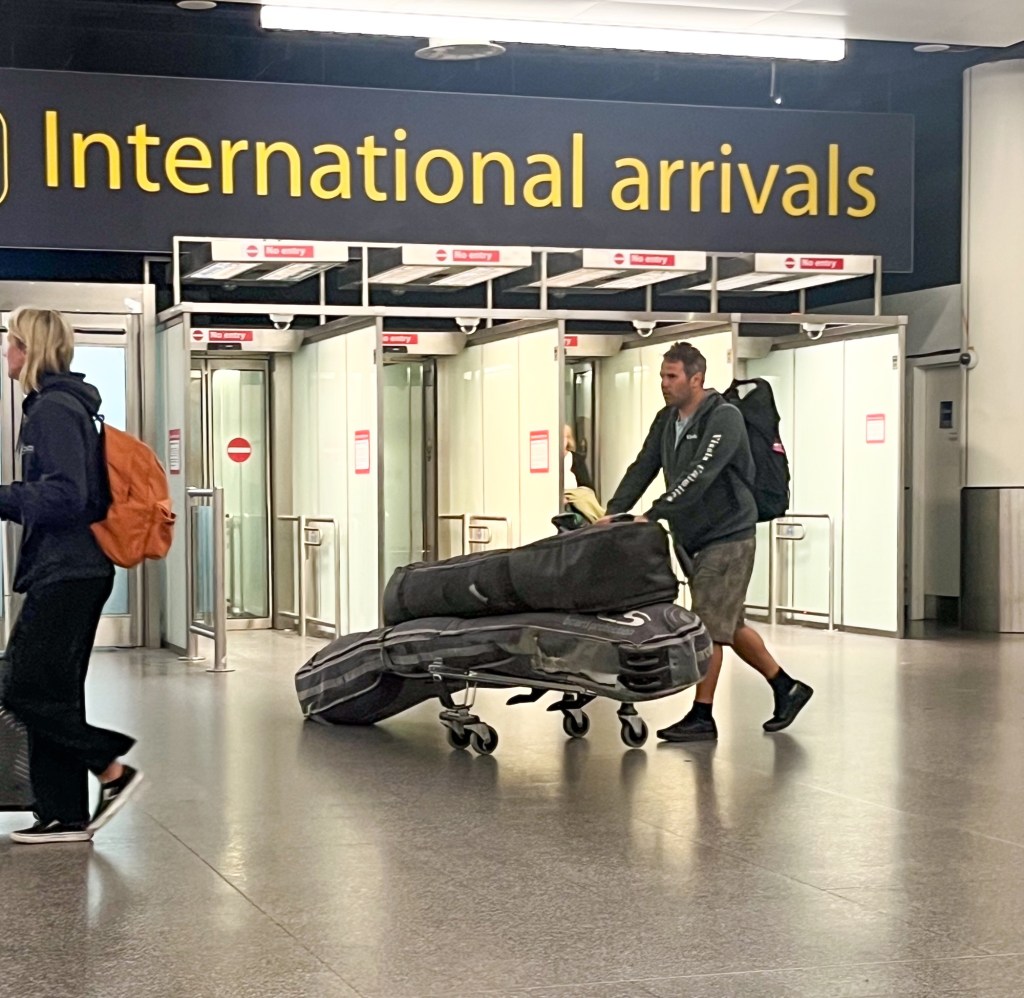
Collecting my soul mate from Heathrow at 6am on Sunday morning was an interesting experience. Firstly there were lots of people in the international arrivals section wearing jackets with ISS written across the back which I assumed meant that had recently arrived from the International Space Station. I never knew they operated out of Gatwick. Then it turned out that ISS are a company who provided cleaning and sanitation support to aircraft terminals amongst other things. They are however very coy about what their initials stand for, or at least I couldn’t find out from going through their website. They have obviously gone way beyond the acronym since they were founded and ISS probably stands for something that they now consider embarrassing. Then a young couple came through the doors pulling a canoe. This is no joke or at least no exaggeration. The bagged item must have been 3 metres long. The woman looked frantic and the man seemed sheepish as if he knew that normal people don’t have so much baggage with them, or if they do they are rich enough to pay other people to deal with it. Maybe that was his dilemma. He wanted to be an international canoeist but couldn’t quite afford the lifestyle, or rather he could afford the life but not the style. Should have stuck to skiing. Much less awkward.
There was a large family group standing in front to me with “welcome home” balloons, four generations of adults and children, and a large cockapoo. When their loved ones came through the barriers it all went crazy and I managed to sneak in and out of the melee and grab a couple of hugs from strangers without anyone noticing. Okay that’s a lie but it was crazy. The dog in particular jumped through the air and landed in the arms of a man who then carried him around the arrivals lounge like he was Hugh Grant with Martine McCutcheon in the closing scenes of Love Actually. You know the one I mean. Not only does the British Prime Minister come through the same passport controls as every other long haul Tom, Dick and Harriet, his security team look on oblivious whilst a woman in red rushes out of the crowd and jumps at him. Do your job guys. Or at least pretend to look a bit worried.
My soul mate did come running through the barriers with her hand luggage (yes she went to Australia with just the one small bag) and although I am no Hugh Grant she did leap at me with a huge beaming smile and so much love in her eyes that she too should have had a bag the size of a canoe to put it in.
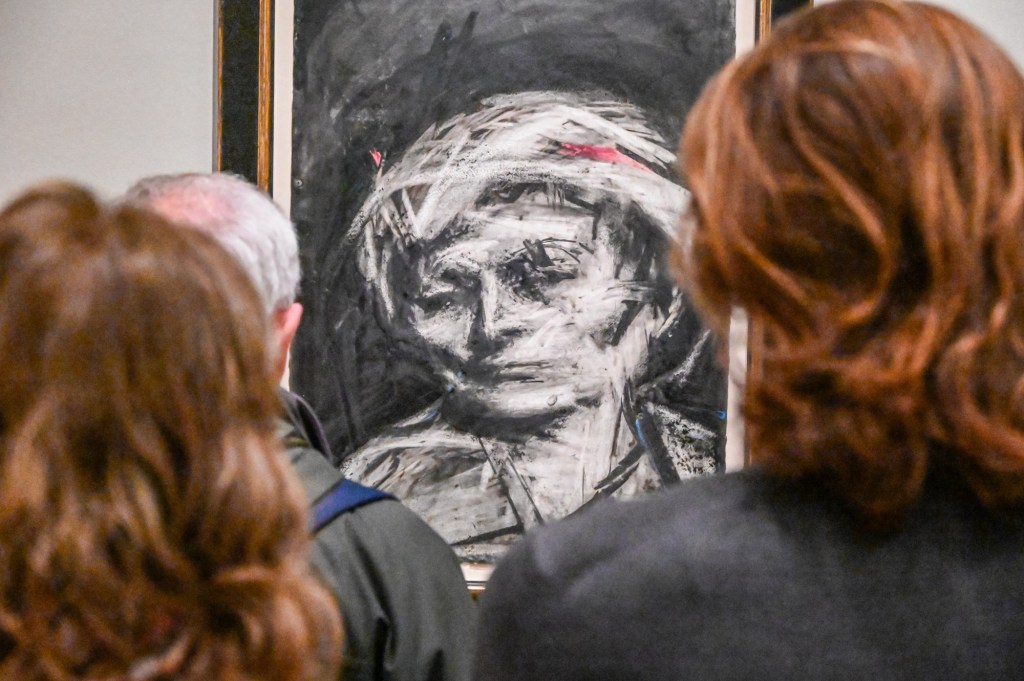
The Frank Auerbach exhibition opened this last week at The Courtauld Gallery to much acclaim, so on Wednesday I duly made my way up to Somerset House to take a look. The technique and the artist’s story are both fascinating and unlike anything I have seen before. A holocaust survivor of the Kindertransport generation, Auerbach lost all his family in the holocaust. If his portraits as seen in this exhibition are stark and scary that is to be expected. But there is also a depth and a surprising positivity to them. Auerbach’s technique was to strip areas of black charcoal from a canvas with a rubber, so you sense the catharsis that goes with taking away as opposed to putting on materials to a work of art. In some ways it is more akin to sculpture and if you look closely in many of them you can see raised areas, ridges and what could be taken for landscape features. Topography meets therapy. The exhibition is small but punches above its weight in terms of impact. Definitely one to catch if you can, it is on until 27th May.
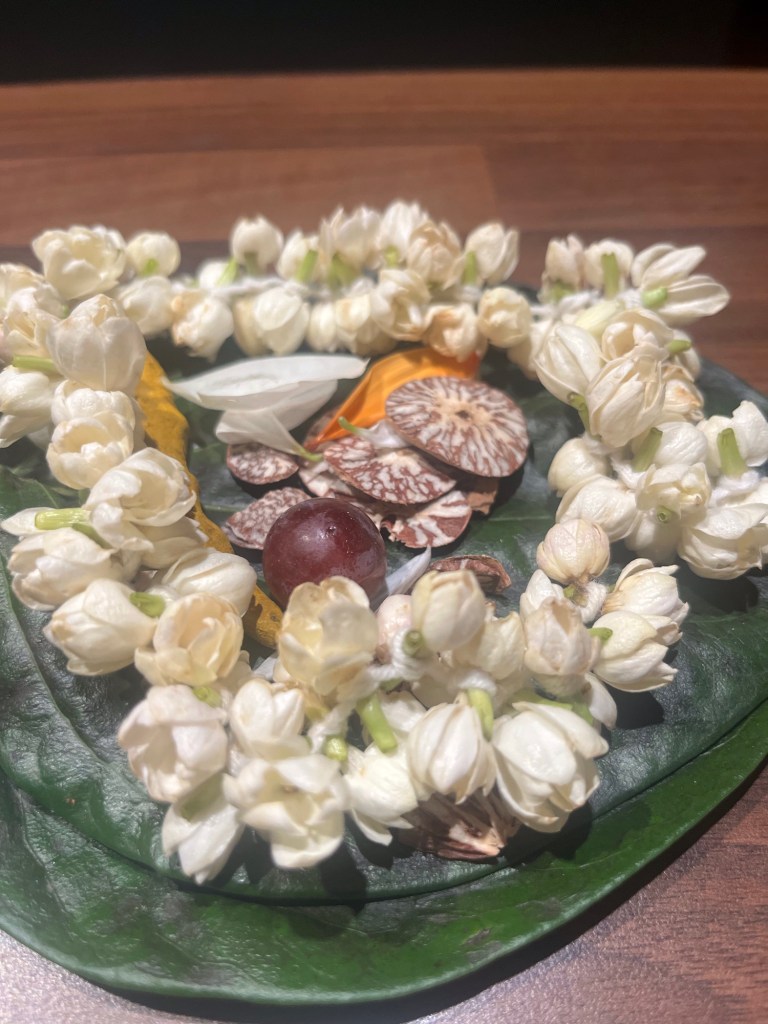
Griha Pravesh puja is a Hindu housewarming ceremony that I had never heard of before until my soul mate was invited to drop in on one by one of her team. She came home with a collection of leaves and fruit and jasmine blossom which now sits in our kitchen.
According to Vastu Shastra, the traditional Hindu system of architecture based on ancient wisdom, a house is made up of five elements – the sun, earth, water, fire and wind. The proper alignment of these elements in a house brings happiness good health and prosperity. I started reading up on this and it is fascinating. Like Feng Shui there is a very deeply rooted set of traditions which are linked to other practices such as astrology and religious belief. Apparently we are in big trouble having a black front door, which explains a lot. It’s sensible if you think about it. A black front door more or less says to visitors “abandon hope all ye who enter here”. Not exactly welcoming. I shall now make it a priority to do something about ours although I am not sure whether to paint it, decorate it or replace it.
There is much wisdom in Vastu Shastra. I particularly liked the emphasis on keeping down the clutter and having a meditation space free of electronics. I was pleased on consulting Google maps to find that our East facing living room is a positive thing, and it is true that in the mornings when it is sunny throughout the year the room does bask in a wonderfully warm glow that fits with the idea of positive energy.
You can be dismissive of concepts such as these but the older I get the more receptive I am to what lies below the surface of the language and traditions. My soul mate bringing back leaves and fruit from someone who is moving into a new house felt like a gift and made me think about our own home. And the Jasmin smelt gorgeous.
The two Daves went head to head on Alexa this week. I looked across the kitchen at the screen and saw she was inviting us to choose between two iconic Daves: Attenborough and Tenant. This seems to be a thing of hers at the moment, inviting us to choose through nonsense polls. But why would anyone choose between them? Is this one of those games where we have to decide who gets thrown out of the balloon? Or apply a formula that compares age with value to society? I also thought it was unfair to have just two choices. There are lots of Daves in the world including my mate Dave Wainwright in Newcastle, who I would vote for over any other Dave on the grounds that we occasionally get drunk together and he therefore has more value to me. Although maybe not my liver.
I have invented a new English word: the Shagabond. A shagabond is a vagabond who likes to shag around. The word came to me after watching episode 1 of Gavin and Stacey this week, which I have never seen before despite the fact that it is much lauded and first aired in 2007. James Cordon’s Smithy character is undoubtedly a shagabond, cheeky and always on the lookout for sex. Try dropping it into conversation and see what happens. Who knows it may catch on.
Don’t Panic
I am an avid Guardian digital subscriber and reader. I have an insatiable desire for knowledge and a need to know what is going on in the world, irrespective of whether it affects me. But this morning, 20th February 2024, I experienced something new a few minutes after settling down for my early morning read: a minor panic attack.
I know what a panic attack feels like. I have had them in connection with work, with loneliness, with relationships, with fear of death and with anxiety about my health. I know what the sense of simultaneously being engulfed and vulnerable can do to me. The dizziness, the need to hug someone, anyone. The rise of an unstoppable heat from my bowels to my throat. The severity of these symptoms vary but they are typical and usually end with a feeling of resignation and overwhelming exhaustion.
Okay, so reading The Guardian didn’t quite send me to the worst of these places. It was a mild attack but still completely recognisable. So I made myself stop and go through the headlines that I had scanned and the links I had clicked to understand why I had panicked. Because these things don’t just happen. Pick up any medical, psychology or wellbeing book and you will get the same starting point. Fear is the key that unlocks the physical responses that I have just described. People vary but mine are not unusual.
The trigger is usually a life event, the recalling of trauma, stress, or any of these in conjunction with drugs and alcohol. But this was reading a newspaper. A good quality newspaper at that, not just a rag like the Daily Express running a “we’re all doomed” headline. So I scrolled down from top to bottom to see where it had all gone horribly wrong. And therein lies the problem: the word scrolling.
Most people will be familiar with the expression “doomscrolling”, which earned celebrity status as the Oxford English Dictionary word of the year in 2020. This is the habit of going from one bad news story to another, each time sucking up the negative energy that goes with it. You accumulate this negative energy and it discharges itself eventually in some form of action or feeling. You use it in a stand-up comedy routine. You rant to friends. You go into online forums and end up in word-to-word combat with other doomscrollers and you all end up as pathologically insane trolls.
But then I realised that in this instance of Guardian-induced panic it wasn’t just about the bad news. It was about information and experience and how it confronted me with the minuscule nature of my existence in the face of the enormous body of information and experience that the human race now possesses. Yes there was all the usual stuff. Putin killing people with impunity like some global Michael Corleone with the cynicism of the powerful. A black hole fulled quasar that is munching its was through the universe like some interstellar PacMan and eating a sun a day. The belittling effects of pornography on young women that undermines their self image.
But ironically it’s the lifestyle and culture sections that make me feel bad about myself. There is so much going on in the world, so many people doing incredible things, so many clever books that all seem to be absurdly more brilliant than those from the previous week, so many fantastic films and television programmes, so many stunning photographs from across the world. All this clever shit washes over me and leaves me feeling inadequate. What an earth can I do? It’s as if the world is one big elegant Oscars ceremony and I have turned up with a forged ticket and wearing Primark shorts and an old t-shirt. It is inadequacy induced panic, which is surely the sign of a deflated ego. It is the immune response of an old man living in an age when some eleven year old has got several hundred thousand listeners for their podcast on urban beekeeping. I am jealous of everyone and everything. I have nothing to offer. I am the complete opposite of Zaphod Beeblebrox in the Hitch Hikers Guide to the Galaxy, who shrugged off and paid back attempts to intimidate him by confronting him with how tiny he was compared to the universe. I have dwindled. My later life, to steal a line from Ted Hughes poem Full Moon and Little Freida, feels like “A cool small evening shrunk to a dog bark and the clank of a bucket”.
It is perhaps unsurprising that this should hit me a few weeks after my retirement. I have barely stopped in this time, and have even complained at the lack of downtime in my life. But I don’t have the long skirts of meaningful employment to hide behind any more; they have swished away and left me standing there at the Oscars in my pound shop pose, and everyone can see that I am (to quote the silicon life form in Episode 18 of Star Trek: The Next Generation) just another ugly bag of mostly water on a planet of 8.09234238 billion of them (as of today’s date).
Joking aside this is the real crux of getting older: staying relevant. But it’s here that you have a choice of perspectives. The first is to ask how much you can lead a self contained life, find pleasure in your own company and not worry about anything beyond your personal boundaries. Some people are very good at this. They have no qualms about living in a small world of their own, particularly if there life has been a long and busy one devoted at least in large pat to the service of others (which mine has). Then there are friends and family, most of whom value us far more than we realise and who don’t care what goes on beyond the boundaries of our immediate circles. The old BBC TV series Last of the Summer Wine, which ran for nearly forty years, nailed this nicely because it was generally age-positive in its outlook and saw old age as something to be enjoyed. The writer, Roy Clarke, proposed that the men should all be unmarried, widowed, or divorced and either unemployed or retired, leaving them free to roam around like adolescents in the prime of their lives, unfettered and uninhibited. And as we know adolescence does not worry about meaning. It is enough to laugh and to be loved without a care for the future.
So don’t do what I did and panic when you read The Guardian and feel both overwhelmed and inadequate. The world has quite a few great and clever people producing wonderful things, but few of us get to join their ranks. And it is not our job to either solve or worry about the world’s big problems other than we can do our bit on a daily basis to lead a good life and inspire others to do the same. As one Hebrew prayer book wisely says: “The day is short, the task is great … it is not your duty to finish the work but neither are you free to neglect it.” I for one am going to get out there and own it, enjoy it, document it for my own pleasure, not compare myself to others greater than me, and not worry about what happens next.
 Eyecatching